Custom Software vs Off-the-Shelf Software: Which Is Right for Your Business?

At some point, every growing business runs into the same problem. The tools that worked in the early days suddenly stop fitting the way the company operates. Maybe your team is juggling too many SaaS tools. Maybe your workflows are being forced into software that wasn't designed for your process. Or maybe you're paying for multiple subscriptions that still don't fully solve the problem. This is usually the moment when a key question comes up: Should we build custom software or just use an off-the-shelf solution? The answer isn't always obvious. Both options have clear advantages, but they solve very different types of problems. In this article, we'll break down the real differences between custom software and off-the-shelf tools, when each makes sense, and how to decide what is right for your business.
What Is Off-the-Shelf Software?
Off-the-shelf software refers to ready-made products that you can buy and start using immediately.
Examples include:
CRM platforms like Salesforce or HubSpot
Project management tools like Asana or Trello
E-commerce platforms like Shopify
Accounting tools like QuickBooks
These products are designed to serve a wide audience. That means they come with standard features that work for most businesses, but not necessarily for yours.
The biggest advantage is simple: you can start using them right away.
No development. No setup complexity. No waiting.
But that convenience comes with limitations.
What Is Custom Software?
Custom software is built specifically for your business.
Instead of adapting your workflows to fit a tool, the software is designed around how your business actually operates.
It can include:
Internal management systems
Customer-facing platforms
Automation tools
Data dashboards
Industry-specific applications
Custom software is usually built by a development team from scratch or on top of modern frameworks.
It takes longer to build, but it is designed to solve your exact problem, not a generalized version of it.
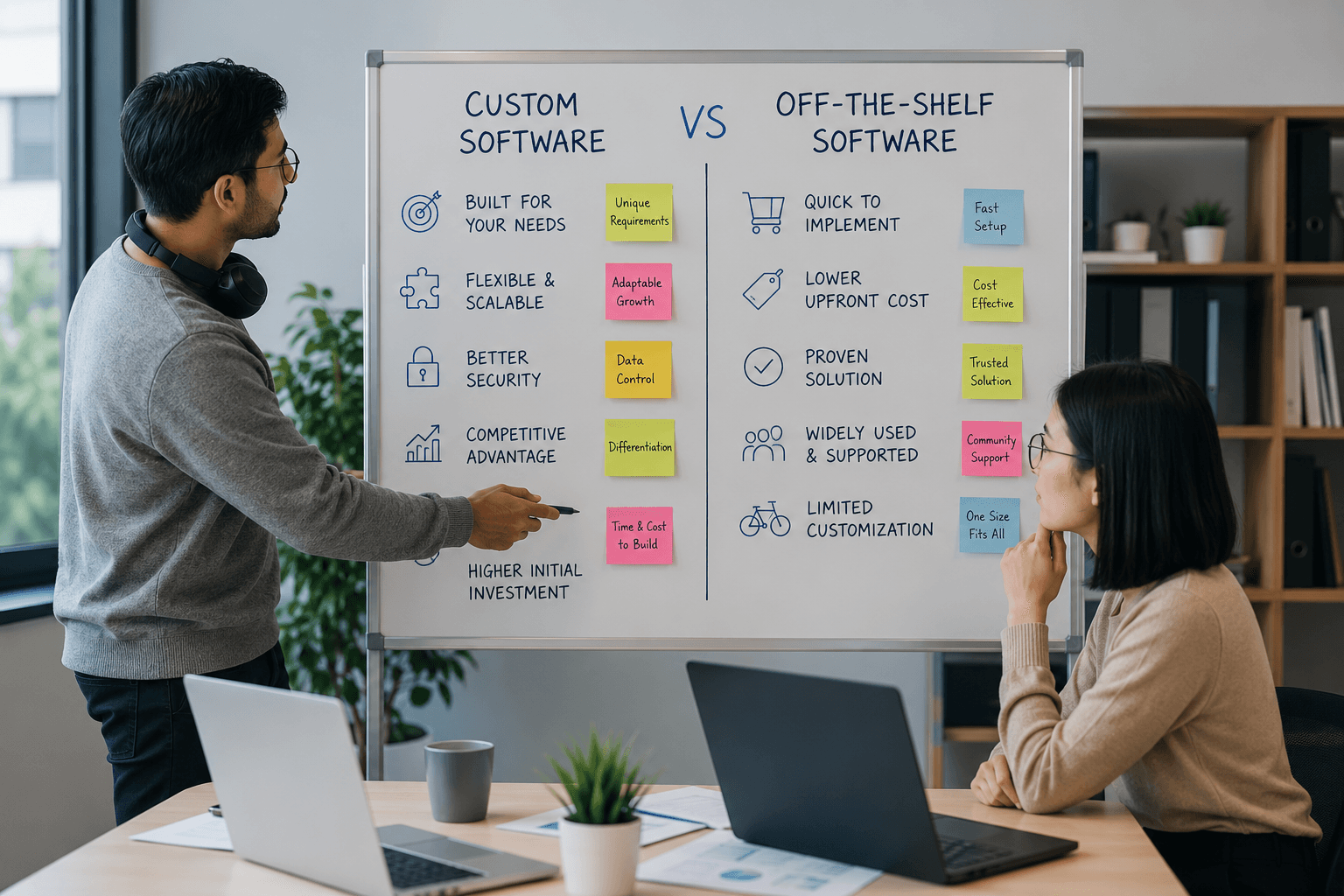
The Key Difference: Flexibility vs Speed
The easiest way to understand the difference is this:
Off-the-shelf software gives you speed
Custom software gives you control
Off-the-shelf tools are fast because everything is already built. You just sign up and start using them.
Custom software takes time because it's designed around your specific workflows, integrations, and business logic.
Most companies don't choose between good and bad software.
They choose between:
"What works now" vs "what will scale later"
When Off-the-Shelf Software Makes Sense
Off-the-shelf tools are often the right choice in the early stages of a business.
They work best when:
1. You need to move fast
If you're launching quickly, you don't want to spend months building internal tools.
2. Your processes are standard
If your workflows are similar to most companies in your industry, existing tools may already be enough.
3. The budget is limited
Subscription tools usually cost far less upfront than custom development.
4. You’re testing ideas
If you're still experimenting with your business model, flexibility matters more than perfection.
In these cases, using existing software is often the smartest decision.
When Custom Software Becomes the Better Option
As businesses grow, limitations of off-the-shelf tools become more visible.
Custom software starts making sense when
1. You are using too many tools
If your team is constantly switching between platforms, productivity suffers.
2. Your workflows are unique
Some businesses operate in ways that standard tools simply don't support.
3. You need deeper automation
When manual work becomes expensive, custom systems can replace repetitive processes.
4. You are scaling quickly
Off-the-shelf tools often struggle with complexity at scale.
5. Data becomes strategic
If your data is a competitive advantage, owning your software becomes important.
The Hidden Cost of Off-the-Shelf Software
At first glance, subscription tools seem cheaper.
But costs often accumulate over time:
Monthly subscriptions across multiple tools
Add-ons and premium features
Integration tools to connect systems
Manual workarounds for missing features
Lost productivity due to switching between platforms
In many cases, companies end up paying for tools that still don't fully meet their needs.
This is where businesses start reconsidering whether custom software might actually be more cost-effective in the long run.
The Reality of Custom Software Costs
Custom software does require a higher initial investment.
Typical ranges:
Simple internal tools: $20,000 – $50,000
Business platforms: $50,000 – $150,000
Complex systems: $150,000 – $500,000+
But unlike subscription tools, you're not renting functionality; you're building an asset that belongs to your company.
Over time, that distinction becomes important.
Which Option Is Better?
There is no universal answer.
But here is a simple way to think about it:
If your process can adapt to the tool → use off-the-shelf software
If the tool must adapt to your process → build custom software
Most businesses actually end up using a combination of both.
For example:
Shopify for e-commerce
Custom system for inventory management
HubSpot for CRM
Custom dashboard for analytics
The goal is not to replace everything.
The goal is to remove friction where it matters most.
A Common Mistake Businesses Make
One of the biggest mistakes companies make is building custom software too early.
Just because something can be built doesn't mean it should be built immediately.
In the early stages, speed and validation matter more than control.
On the other hand, waiting too long can also become a problem when existing tools start slowing down growth.
The key is timing.
Final Thoughts
The decision between custom software and off-the-shelf tools is not just a technical one. It's a strategic decision about how your business operates and scales.
Off-the-shelf software helps you move fast and stay flexible in the early stages.
Custom software gives you control, efficiency, and scalability when your processes become more complex.
The smartest companies don't permanently choose one or the other.
They evolve their systems as their business grows.
Need Help Deciding?
At Shiftr, we help companies evaluate whether they should use existing tools or build custom software tailored to their needs. In many cases, the right answer is a hybrid approach that balances speed, cost, and long-term scalability.